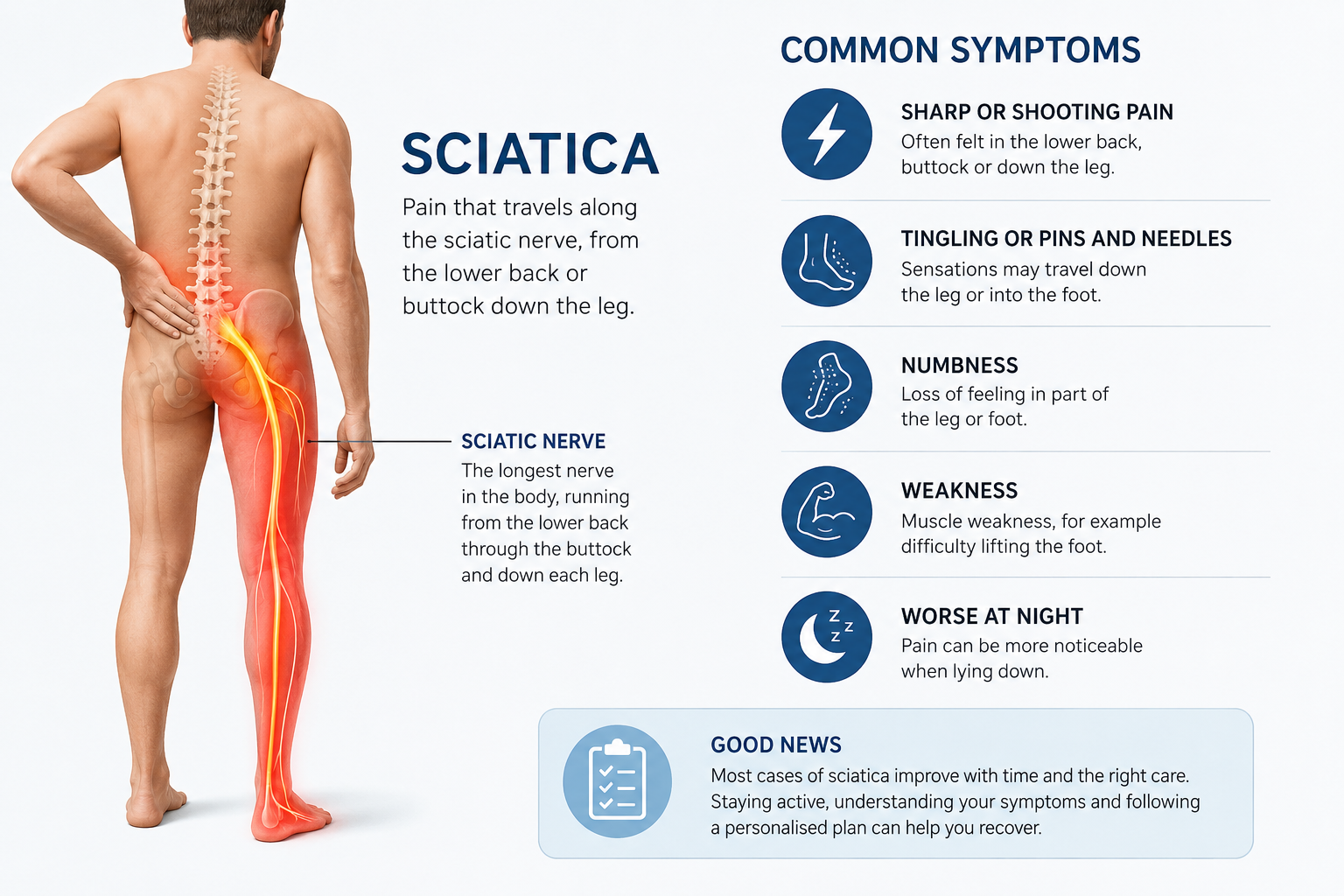
If you are looking for sciatica treatment in South East London, this guide explains the symptoms, possible causes, assessment and evidence-informed care options. Sciatica commonly describes pain that travels from the lower back or buttock into the leg. It may feel burning, electric, sharp or aching, and some people also experience tingling, numbness or weakness.
The term does not identify one single structure or one universal treatment. Sciatica can arise when a nerve root in the lower back is irritated or compressed, but similar leg symptoms can also have other causes. A careful history and examination are therefore more useful than assuming that every episode is a “slipped disc” or a trapped nerve.
What does sciatica mean?
In everyday language, sciatica usually means back-related leg pain following the distribution of the sciatic nerve. Clinicians may use more specific terms:
- Radicular pain: pain thought to arise from irritation of a spinal nerve root.
- Radiculopathy: nerve-root dysfunction accompanied by objective findings such as altered strength, sensation or reflexes.
- Referred leg pain: pain felt in the leg without clear evidence of nerve-root dysfunction.
These categories can overlap. Symptoms alone do not always reveal the exact cause, and imaging findings do not automatically explain pain.
Common symptoms
- Pain travelling from the back or buttock into one leg.
- Burning, electric, shooting or sharp leg pain.
- Tingling or altered sensation in the thigh, calf or foot.
- Numbness in part of the leg or foot.
- Weakness, such as difficulty lifting the front of the foot or repeatedly rising onto the toes.
- Symptoms aggravated by particular positions, coughing, sneezing, bending or prolonged sitting.
Pain does not have to travel below the knee to be nerve-related, and pain below the knee is not proof of sciatica. The overall pattern, neurological examination and symptom behaviour matter more than any single feature.
What can cause sciatica?
A lumbar disc herniation is a common cause, particularly in younger and middle-aged adults. Disc material can contribute through mechanical contact, inflammation or both. Other possible causes include narrowing around a nerve root, degenerative spinal changes and, less commonly, conditions outside the spine such as deep gluteal nerve entrapment.
It is misleading to describe every episode as a nerve being permanently “pinched,” “stuck” or “out of place.” Nerve-related pain is influenced by inflammation, mechanical sensitivity, sleep, stress, activity tolerance and the wider health context. Sitting may aggravate symptoms without causing damage.
How is sciatica assessed?
An assessment normally considers the distribution and duration of symptoms, aggravating and easing factors, strength, reflexes, sensation and movements that alter the leg pain. Straight-leg-raise and slump tests may contribute, but research shows that neurodynamic tests have limited diagnostic accuracy when used alone. A cluster of findings is more informative than one positive test.
Magnetic resonance imaging (MRI) is not routinely required for every new episode of sciatica. The National Institute for Health and Care Excellence (NICE) advises against routine imaging in non-specialist settings. Imaging may be considered when the result is likely to change treatment or when a serious underlying condition is suspected.
What does the treatment evidence show?
Recent systematic reviews show an important distinction between a treatment having some supportive evidence and one treatment being clearly superior. A 2025 network meta-analysis of acute and subacute sciatica found only very-low-confidence evidence for the available non-surgical interventions. A separate 2025 review of chronic sciatica similarly found no high-quality evidence confirming one superior non-surgical treatment.
Neural mobilisation is one potentially useful component. A 2023 meta-analysis reported improvements in pain and disability, but the studies were highly heterogeneous and affected by potential publication bias and variable quality. It should therefore be presented as an option rather than as a method that “unpins” or decompresses a nerve.
NICE recommends self-management and exercise selected according to the person’s needs and capabilities. Manual therapy, including mobilisation and soft-tissue techniques, may be considered only as part of a package that includes exercise. NICE advises against traction for low-back pain with or without sciatica.
Where do osteopathy and massage fit?
Hands-on treatment may help some people move more comfortably or tolerate activity. It should not be marketed as physically putting a disc back into place, releasing a trapped nerve or permanently correcting alignment. At Momentum Body Clinic, any manual treatment is combined with explanation, movement advice and an appropriate progression of activity or exercise.
Does everyone need surgery?
No. Disc herniations can reduce in size over time, particularly extruded and sequestrated herniations. A 2024 meta-analysis reported radiological resorption in about 70% of conservatively managed lumbar disc herniations overall. Imaging change and symptom recovery are not the same thing, however, and the statistic does not mean that 70% of all people with sciatica recover by a particular date.
For people who already have a surgical indication, discectomy can provide faster leg-pain relief. A 2023 meta-analysis found that the average advantage reduced over time and was negligible at long-term follow-up. Decisions about surgery depend on symptom severity, neurological findings, duration, patient preference and specialist assessment.
Seek emergency assessment
Attend A&E urgently if back or leg pain is accompanied by new difficulty starting or controlling urination, loss of awareness of bladder filling, new bowel incontinence, altered sensation around the genitals or anus, new sexual dysfunction, or severe/rapidly worsening weakness in both legs. These symptoms can occur with cauda equina syndrome and require emergency assessment.
Progressive weakness in one leg, foot drop, fever, unexplained weight loss, significant trauma or feeling seriously unwell also require prompt medical advice.
Explore the full series
Book an osteopathy assessment
If back or leg symptoms are affecting work, sleep, walking or training, an assessment can help clarify the pattern, screen for signs that need medical referral and build an individual management plan.
Prefer to ask a question first? Contact Momentum Body Clinic.
Research and guidance
- Ropper AH, Zafonte RD. Sciatica. N Engl J Med. 2015;372:1240–1248. PMID: 25806916.
- Zhu Z, et al. Effectiveness of Nonsurgical Interventions for Patients With Acute and Subacute Sciatica: A Systematic Review With Network Meta-Analysis. J Orthop Sports Phys Ther. 2025;55(6):1–12. PMID: 40434940.
- Zhu Z, et al. Effectiveness of non-surgical interventions for patients with chronic sciatica: a systematic review with network meta-analysis. J Pain. 2025;33:105431. PMID: 40373933.
- Lin LH, et al. Neural Mobilization for Reducing Pain and Disability in Patients with Lumbar Radiculopathy. Life. 2023;13:2255. PMID: 38137856.
- Zou T, et al. Incidence of Spontaneous Resorption of Lumbar Disc Herniation. Orthop Rev. 2024. PMID: 37559207.
- Liu C, et al. Surgical versus non-surgical treatment for sciatica. BMJ. 2023;381:e070730. PMID: 37076169.
- NICE. Low back pain and sciatica in over 16s: assessment and management (NG59).
This article provides general information and is not a diagnosis or personal medical prescription. Last clinically reviewed: 14 July 2026.