
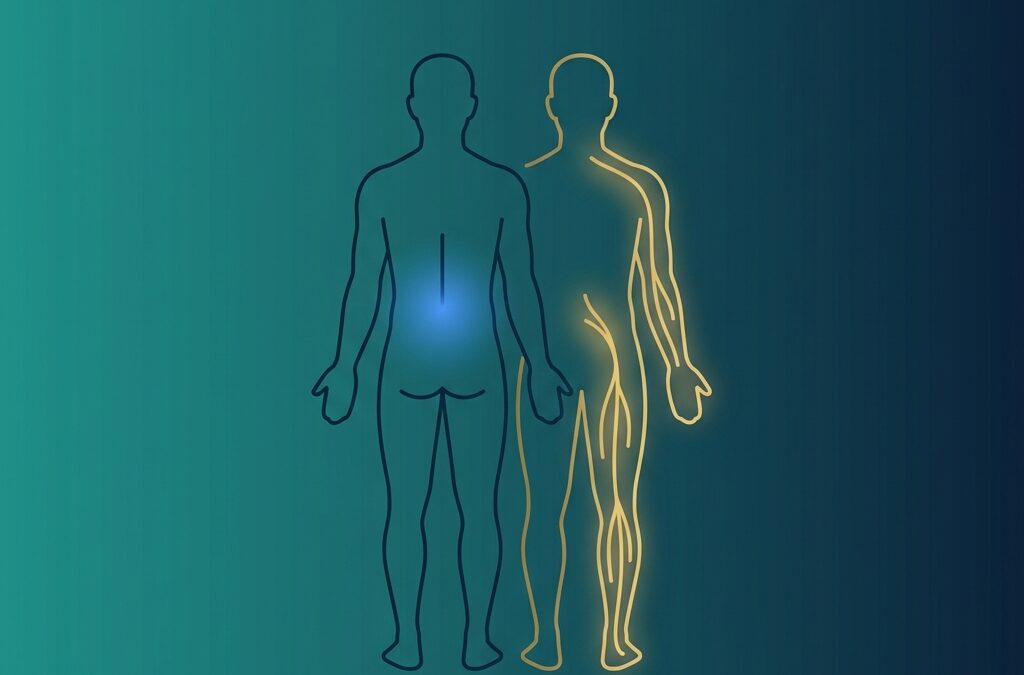
Wondering whether your symptoms are sciatica or back pain? The two can overlap, but they are not interchangeable. Localised lower-back pain can be severe without involving a nerve root, while sciatica usually includes leg symptoms and may occur with relatively little back pain.
No online checklist can diagnose the cause with certainty. The aim of this guide is to help you recognise patterns, understand what an assessment looks for and know when symptoms need urgent medical attention.
Three terms that are often confused
| Term | What it generally means | Typical features |
|---|---|---|
| Non-specific low-back pain | No single serious or clearly identifiable structural cause explains the pain. | Back or buttock pain, stiffness, activity-related symptoms; neurological loss is absent. |
| Radicular pain / sciatica | Leg pain associated with irritation or inflammation of a spinal nerve root. | Radiating, burning, electric or shooting leg pain; back pain may or may not be present. |
| Radiculopathy | Loss of nerve-root function. | Objective weakness, altered sensation or reflex change, sometimes with radicular pain. |
Features that make sciatica more likely
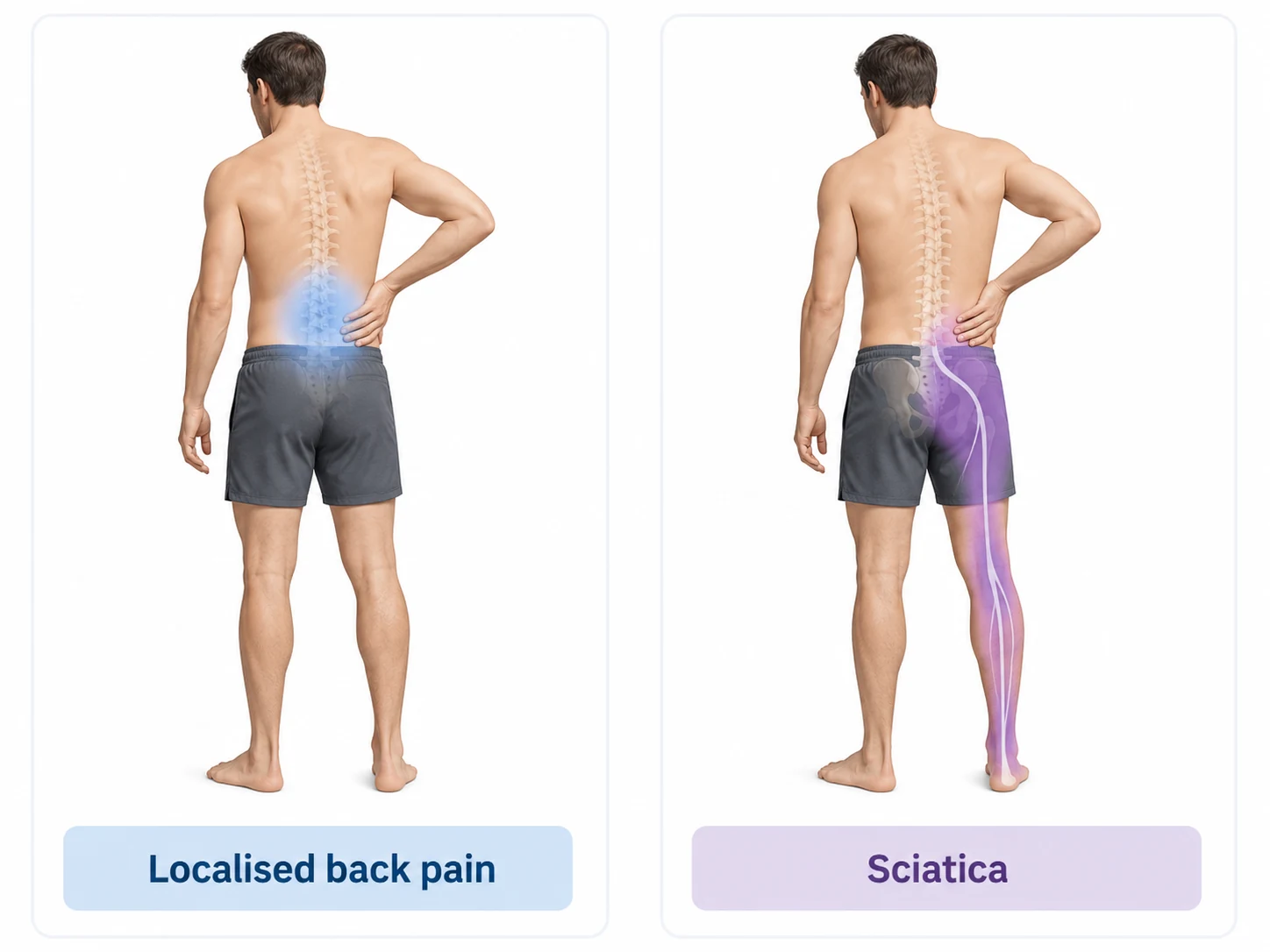
- Pain travels from the back or buttock into the thigh, calf or foot.
- The leg pain feels burning, electrical, sharp or shooting.
- There is tingling, altered sensation or numbness.
- Coughing, sneezing or particular spinal positions reproduce the leg pain.
- There is new weakness, such as difficulty lifting the foot, extending the knee or repeatedly rising onto the toes.
Pain below the knee is common in sciatica, but it is not a definitive test. Sciatica can stop above the knee, and other conditions can refer pain below it. Dermatomal charts are also imperfect: real symptoms do not always follow a neat textbook line.
Features more consistent with localised back pain
- Pain remains mainly in the lower back or buttock.
- There is no numbness, tingling or neurological weakness.
- Symptoms vary with movement, loading, sleep or sustained positions.
- Walking, gentle movement or changing position may help, although this is not universal.
“Non-specific” does not mean imaginary or unimportant. It means that pain cannot be attributed confidently to one tissue and that serious causes have not been identified. Statements such as “your facet is locked,” “your SI joint is out” or “your psoas is pulling the pelvis forward” usually go beyond what a routine examination can establish.
Can the straight-leg-raise or slump test diagnose sciatica?
These tests are useful pieces of an examination, but neither is diagnostic alone. The straight-leg-raise assesses whether a combination of hip, knee and ankle movement reproduces relevant leg symptoms. The slump test uses a different combination of spinal and leg movements.
A Cochrane review found that the straight-leg-raise was often sensitive but poorly specific in surgical populations. A later validation study also concluded that neurodynamic tests generally lacked diagnostic accuracy when compared with MRI findings. This means a negative or positive result changes probability; it does not provide proof.
Clinicians improve interpretation by combining the symptom history with strength, sensation, reflexes, structural differentiation and the behaviour of symptoms during movement.
What about the FAIR and facet-loading tests?
Reproduction of buttock pain during a FAIR test may contribute to the assessment of deep gluteal symptoms, but it does not prove that the piriformis is compressing the sciatic nerve. Similarly, pain during extension and rotation does not establish a facet-joint diagnosis. These findings should be treated as clues rather than labels.
Is MRI the answer?
MRI can identify disc herniation, narrowing and other anatomical changes. It can also show findings in people without symptoms. For that reason, imaging is most useful when the result is likely to change treatment, when surgery or an injection is being considered, or when serious pathology is suspected. NICE advises against routine imaging in non-specialist settings.
What a useful assessment should include
- The onset, distribution, severity and duration of symptoms.
- Questions about bladder, bowel, saddle sensation, sexual function, trauma, fever and general health.
- Strength, reflex and sensory testing where appropriate.
- Movement and neurodynamic testing interpreted as a group.
- Discussion of work, sleep, activity, beliefs, goals and previous episodes.
- A clear explanation of uncertainty and when referral or imaging is appropriate.
Do not self-test through severe symptoms
Repeatedly forcing a slump or straight-leg-raise is not a safe way to diagnose yourself. Stop and seek assessment if testing produces marked or lasting worsening, new numbness or weakness, or symptoms spreading significantly farther down the leg.
Attend A&E for possible cauda equina symptoms
Seek emergency care for new bladder or bowel dysfunction, altered sensation around the genitals or anus, new sexual dysfunction, or severe/rapidly worsening weakness in both legs.
What happens after the pattern is identified?
Treatment is normally based on function and symptom response rather than the name of one damaged structure. Advice may include graded activity, selected exercises, work modifications and—where appropriate—manual therapy as one part of an active programme. The next article explains how exercises can be selected without pretending that one routine suits everyone.
Book an osteopathy assessment
If back or leg symptoms are affecting work, sleep, walking or training, an assessment can help clarify the pattern, screen for signs that need medical referral and build an individual management plan.
Prefer to ask a question first? Contact Momentum Body Clinic.
Research and guidance
- Ropper AH, Zafonte RD. Sciatica. N Engl J Med. 2015. PMID: 25806916.
- van der Windt DA, et al. Physical examination for lumbar radiculopathy due to disc herniation in patients with low-back pain. Cochrane Database Syst Rev. 2010. PMID: 20166095.
- Ekedahl H, et al. Accuracy of Clinical Tests in Detecting Disk Herniation and Nerve Root Compression. Arch Phys Med Rehabil. 2018;99:726–735. PMID: 29253501.
- Nee RJ, et al. Reliability of the straight leg raise test for suspected lumbar radicular pain. Musculoskelet Sci Pract. 2022. PMID: 35245880.
- NICE. Low back pain and sciatica in over 16s: assessment and management.
General information only. Last clinically reviewed: 11 July 2026.