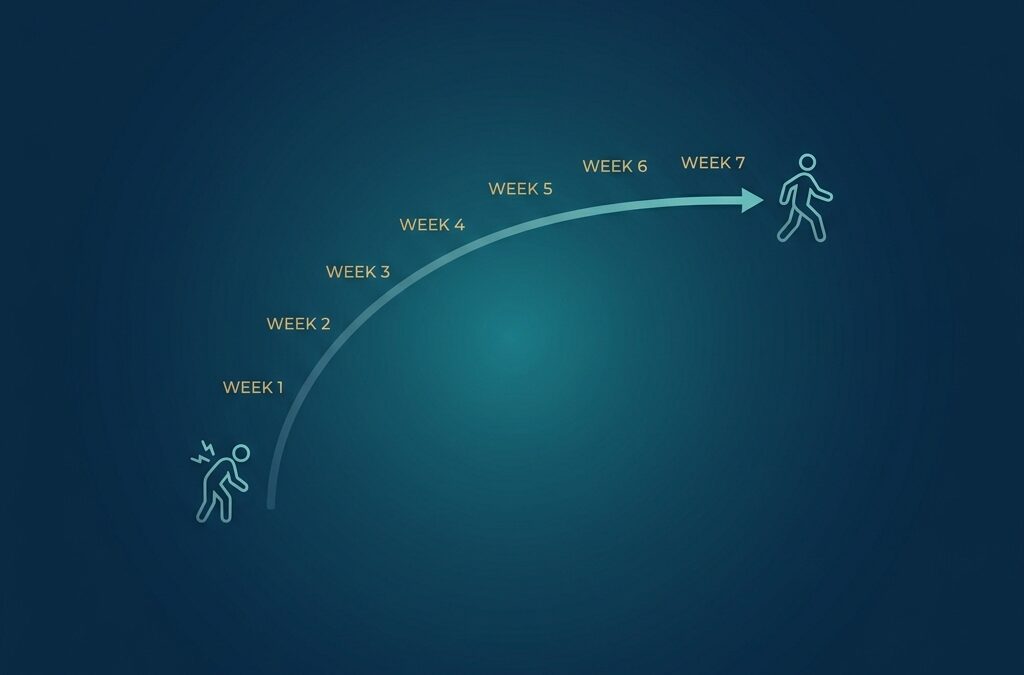
How long does sciatica last? It is one of the most understandable questions after a flare. Unfortunately, no responsible clinician can promise that every episode will resolve within six or twelve weeks.
Many people improve substantially over the first weeks or months, but sciatica is often more persistent than localised low-back pain. In a UK primary-care cohort, only 55% of participants classified with sciatica achieved the study’s definition of improvement at 12 months. That does not mean recovery is unlikely; it means a rigid week-by-week guarantee is misleading.
Why recovery timelines vary
- The cause differs: disc herniation, inflammatory radicular pain, spinal narrowing and non-spinal causes do not follow one timetable.
- Symptoms differ: pain, numbness and weakness may recover at different rates.
- Starting point differs: someone walking comfortably with intermittent pain has a different prognosis from someone with constant severe pain and neurological loss.
- Life demands differ: heavy manual work, caring responsibilities, sleep loss and limited opportunity to modify activity can influence recovery.
- Beliefs and distress matter: the ATLAS cohort found that expecting the problem to last a long time was associated with poorer outcome, but this does not mean pain is psychological or the patient is to blame.
Can a disc herniation shrink over time?
Disc material can reduce in size. A 2024 meta-analysis of 31 studies and 2,233 conservatively managed patients found an overall radiological resorption incidence of 70.39%. Rates differed by morphology: sequestrated and extruded herniations were more likely to resorb than protrusions or bulges.
This evidence is reassuring, but it is often misused. Disc resorption:
- does not occur in every person;
- does not follow an exact week-by-week schedule;
- is an imaging outcome, not the same as pain, strength or return to work;
- does not prove that a more dramatic MRI always gives a better clinical prognosis.
A flexible recovery framework
Use stages rather than fixed weeks. People can move forwards and backwards between them.
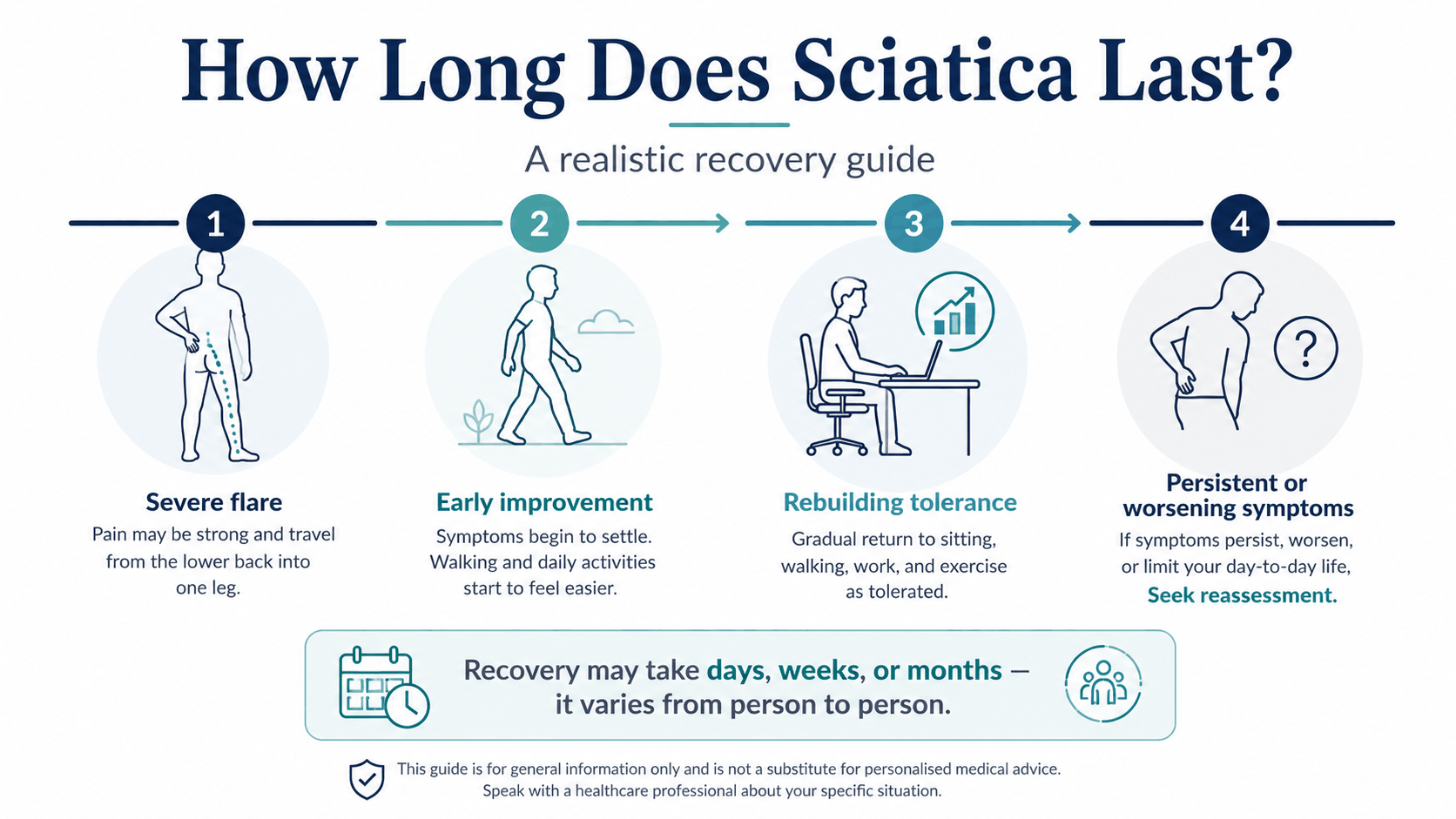
Stage 1: protecting function during a severe flare
The early goal is not to “fix” the spine in a few days. It is to maintain essential movement, identify emergency symptoms, find tolerable positions and prevent fear-driven complete inactivity.
- Change position regularly.
- Use short walks or ordinary household movement within tolerance.
- Discuss medication with a pharmacist or prescriber rather than relying on online advice.
- Use one or two gentle exercises only when they settle or do not substantially worsen symptoms.
- Arrange assessment when pain is severe, function is markedly limited or neurological symptoms are present.
There is no evidence-based rule that everyone must avoid sitting for more than 20 minutes or perform nerve sliders twice daily.
Stage 2: rebuilding daily tolerance
As symptoms become less constant, the aim is to increase walking, sitting, sleep and basic work tolerance. Progress is often uneven. A difficult day after increased activity does not automatically indicate renewed injury.
- Increase one activity at a time.
- Use symptoms and next-day response to adjust volume.
- Introduce trunk or hip strengthening when tolerated.
- Address work setup and pacing without searching for one perfect posture.
Stage 3: restoring strength and confidence
Once ordinary movement is more reliable, rehabilitation should resemble the person’s actual goals. A runner may rebuild impact tolerance; a warehouse worker may practise lifting; a desk worker may lengthen sitting periods and add regular movement.
- Progress resistance gradually.
- Practise the relevant lift, carry, run or work task.
- Expect some symptom fluctuation during reloading.
- Monitor strength and neurological changes rather than pain alone.
Stage 4: persistent or worsening symptoms
Reassessment is appropriate when symptoms are not improving, function is deteriorating or weakness is progressing. Persistent symptoms do not automatically mean surgery is necessary, but they may justify medical review, imaging or specialist discussion when the result would change management.
Does guided rehabilitation guarantee faster recovery?
No. Advice, exercise and clinical support can help a person stay active and progress safely, but current research does not show that the strongest predictor of chronicity is whether someone followed a guided rehabilitation programme. A systematic review of non-surgically treated sciatica found limited and inconsistent evidence for most proposed prognostic factors.
It is therefore inappropriate to claim that support makes the difference between a six-week and six-month recovery. A more honest promise is that assessment can improve decision-making, identify concerning change and provide a structured progression.
Do you need an MRI if recovery is slow?
Not automatically. The National Institute for Health and Care Excellence (NICE) advises against routine imaging in non-specialist settings for lower-back pain with or without sciatica. Imaging is more useful when a serious cause is suspected or when the result is likely to change treatment, such as specialist consideration of an injection or surgery.
An MRI finding should be interpreted alongside symptoms and examination findings. A disc change on a scan does not provide an exact recovery date.
Surgery versus conservative care
A 2023 systematic review of 24 randomised trials found that discectomy offered faster average relief of leg pain for people with sciatica who had a surgical indication. The difference was moderate in the immediate and short term, small in the medium term and negligible at long-term follow-up. Certainty ranged from very low to low.
This does not mean surgery and conservative care are identical for every individual. Surgery may be appropriate when rapid relief is particularly valuable, symptoms are persistent and severe, or neurological findings require specialist management. Emergency surgery is considered separately when cauda equina syndrome is suspected.
When should you seek reassessment?
- Weakness is new or worsening.
- The foot begins to drag or walking becomes less safe.
- Pain remains severe and disabling despite appropriate initial care.
- Symptoms are not showing a general improving trend.
- There is fever, unexplained weight loss, major trauma or significant general illness.
- You are unsure how to return to work, lifting, running or sport.
Emergency symptoms
Attend A&E for new difficulty starting or controlling urination, loss of bladder sensation, bowel incontinence, altered sensation around the genitals or anus, new sexual dysfunction, or severe/rapidly worsening weakness in both legs.
What counts as progress?
Recovery is broader than a zero pain score. Useful signs include:
- better sleep;
- longer walking or sitting tolerance;
- less frequent leg pain;
- symptoms no longer reaching as far down the leg;
- improving strength and confidence;
- return to work, exercise or social activity.
Frequently asked questions
Can sciatica go away on its own?
Yes, many episodes improve without surgery. However, recovery is variable, and persistent pain, numbness or weakness should be reassessed rather than managed indefinitely without review.
Is six weeks a guaranteed recovery time?
No. Some people improve sooner, while others need several months. Six weeks can be a useful review point, but it is not a deadline by which every symptom must disappear.
Can numbness or weakness last longer than pain?
Yes. Pain, altered sensation and strength do not always recover at the same rate. New or worsening weakness needs prompt medical assessment.
Does a flare mean recovery has restarted from the beginning?
Not necessarily. Symptoms can fluctuate as activity increases. Review the overall trend, function and neurological changes rather than judging recovery from one difficult day.
Book an osteopathy assessment
If back or leg symptoms are affecting work, sleep, walking or training, an assessment can help clarify the pattern, screen for signs that need medical referral and build an individual management plan.
Prefer to ask a question first? Contact Momentum Body Clinic.
Research and guidance
- Konstantinou K, et al. Prognosis of sciatica and back-related leg pain in primary care: the ATLAS cohort. Spine J. 2018;18:1030–1040. PMID: 29174459.
- Verwoerd AJH, et al. Prognostic factors predicting outcome in non-surgically treated patients with sciatica. Eur J Pain. 2013;17:1126–1137. PMID: 23494852.
- Zou T, et al. Incidence of Spontaneous Resorption of Lumbar Disc Herniation. 2024. PMID: 37559207.
- Chiu CC, et al. The probability of spontaneous regression of lumbar herniated disc. Clin Rehabil. 2015. PMID: 25009200.
- Liu C, et al. Surgical versus non-surgical treatment for sciatica. BMJ. 2023;381:e070730. PMID: 37076169.
- Akuthota V, et al. Clinical Course of Motor Deficits from Lumbosacral Radiculopathy. PM R. 2019. PMID: 30689304.
- National Institute for Health and Care Excellence. Low back pain and sciatica in over 16s: assessment and management (NG59).
General information only. Last clinically reviewed: 15 July 2026.