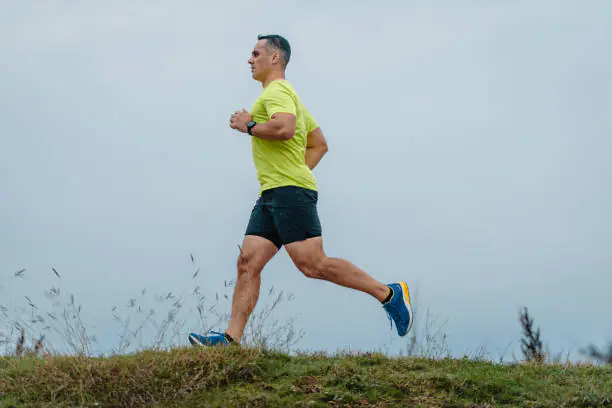
Running after 35 does not mean your body suddenly becomes fragile or unable to adapt. Thirty-five is not a biological switch. Changes in endurance performance and recovery occur gradually and vary considerably according to training history, health and activity levels. We use the post-35 framing here as a useful audience label — not as a physiological cliff. Your body at 42 is different from your body at 22, but many of the changes relevant to running remain trainable with sensible loading, appropriate recovery and an understanding of your current baseline.
What actually changes after 35 — and what the evidence shows about trainability
1. Aerobic capacity tends to decline with age — but it responds to training
Aerobic capacity tends to decline gradually with age, but it remains trainable. Research on masters endurance athletes suggests peak endurance performance is often maintained to around the mid-thirties, followed by relatively modest average declines through the following decades before steeper declines later in life. Continued endurance training can substantially influence this trajectory, although ageing itself still affects aerobic capacity.
2. Muscle mass changes — but exercise significantly influences the trajectory
Ageing is associated with gradual changes in muscle mass, strength and power, but the rate and extent of those changes are strongly influenced by activity level, resistance exercise, health and training history.
A cross-sectional study of highly active masters athletes aged 40–81 found relatively preserved thigh muscle area and strength across age groups (Wroblewski et al., 2011). Because the study was observational, it cannot prove that exercise prevents ageing-related muscle loss, but it does show how different muscle ageing can look in people who remain highly active.
3. Tendons change with age — but they remain adaptable
Tendons also change with age, but they remain responsive to mechanical loading. Reviews of human tendon research suggest ageing is associated with changes in cellular activity and tendon mechanical properties, while exercise can positively influence tendon adaptation (Svensson et al., 2016).
This does not mean every runner over 35 automatically needs longer recovery; progression should be based on training history, symptoms and response to load rather than age alone.
4. Recovery may take longer — and this is not a weakness
Recovery varies considerably between individuals. Rather than using age alone to determine how long to wait between sessions, pay attention to how you respond later that day and the following morning. Persistent soreness, unusual fatigue, reduced function, or symptoms that are getting progressively worse are useful signs that the current training load may need adjusting.
A run that leaves you significantly tired or sore two days later is providing useful information about your current load capacity.
4 practical adjustments that matter
1. Give yourself enough recovery between running sessions
A non-running day between sessions is a sensible starting structure for new runners. If soreness or fatigue has not settled, taking an additional day is reasonable. There is no fixed recovery interval that applies to everyone over 35.
2. Add some tendon loading work early
Simple calf-strengthening exercises such as heel raises are one way to introduce controlled tendon and muscle loading alongside running. The appropriate volume depends on your starting strength, current symptoms and overall training load, so a fixed dose is not necessary for everyone.
3. Notice how you respond between sessions
Pay attention to soreness, fatigue, stiffness and function later that day and the following morning. The trend across several sessions is more useful than one specific time threshold.
4. Take sleep seriously — but keep it in perspective
Sleep genuinely matters for health, recovery and performance and is worth protecting. However, the relationship between poor sleep and sports injury in adults is less certain than is sometimes presented. A 2021 systematic review found limited evidence that poor sleep independently increases injury risk in adult athletic populations. Think of sleep as one important part of recovery rather than a standalone injury-prevention tool.
When to get a clinical assessment
You do not need a clinical assessment simply because you are over 35 or starting running. Most people can begin gradually without treatment. An assessment may be useful if symptoms are persistent or recurring, a previous injury is limiting your confidence or function, or you are repeatedly unable to progress. Specific signals worth acting on include:
- You have a previous injury — ankle sprain, knee problem, lower back episode — that was never fully assessed or rehabilitated.
- You notice one side consistently feels stiffer, tighter, or more loaded than the other during or after a run.
- Morning stiffness in the hips, lower back or ankles is becoming more persistent or taking progressively longer to ease.
- You are six or more weeks into a programme and progress has plateaued in a way that extra rest is not resolving.
- You have tried running before, reached weeks three or four, and stopped for the same reason each time.
Where do osteopathy and movement assessment fit?
An assessment may consider previous injuries, symptoms, joint movement, strength and relevant movement tasks. These findings are interpreted in the context of the individual rather than treated as automatic causes of pain or injury.
Where appropriate, manual treatment or massage may form part of management alongside exercise, load modification and practical advice.
Our Southwark Park Athletics Track Gym on Hawkstone Road (SE16) is a working gym on a functioning running track, used by people ranging from complete beginners to competitive club runners. Age is not a qualifier for entry. We also offer consultations at our Telegraph Hill clinic on Kitto Road (SE14).
Starting running again and something is holding you back?
If symptoms are persisting, a previous injury is limiting your confidence, or you keep stopping for the same reason, an initial osteopathy consultation can help assess what may be contributing and discuss next steps.
Prefer to ask a question first? Contact Momentum Body Clinic .
- Part 1: "I'm Not a Runner" — How to start running safely in South East London
- Part 2: Your First 4 Weeks of Running: What to Expect & What’s Normal
- Part 3: 3 Common Running Problems in Beginners
- Part 4: Running After 35: What Changes and What Stays Trainable (you are here)
- Part 5: Your First 5K in South East London — A Practical 8-Week Run-Walk Plan
Research and guidance
- Tanaka H, Seals DR. Endurance exercise performance in masters athletes: age-associated changes and underlying physiological mechanisms. J Physiol. 2008;586(1):55–63. PMID: 17717011.
- Wroblewski AP, Amati F, Smiley MA, et al. Chronic exercise preserves lean muscle mass in masters athletes. Phys Sportsmed. 2011;39(3):172–178. PMID: 22030953.
- Svensson RB, Heinemeier KM, Couppé C, Kjaer M, Magnusson SP. Effect of aging and exercise on the tendon. J Appl Physiol. 2016;121(6):1237–1246. PMID: 27150831.
- Pedisic Z, Shrestha N, Kovalchik S, et al. Is running associated with a lower risk of all-cause, cardiovascular and cancer mortality, and is the more the better? A systematic review and meta-analysis. Br J Sports Med. 2020;54(15):898–905. PMID: 31685526.
- Dobrosielski DA, Sweeney L, Lisman PJ. The Association Between Poor Sleep and the Incidence of Sport and Physical Training-Related Injuries in Adult Athletic Populations: A Systematic Review. Sports Med. 2021;51(4):777–793. PMID: 33560506.
This article provides general information and is not a diagnosis or personal medical prescription. Last clinically reviewed: 28 September 2026.