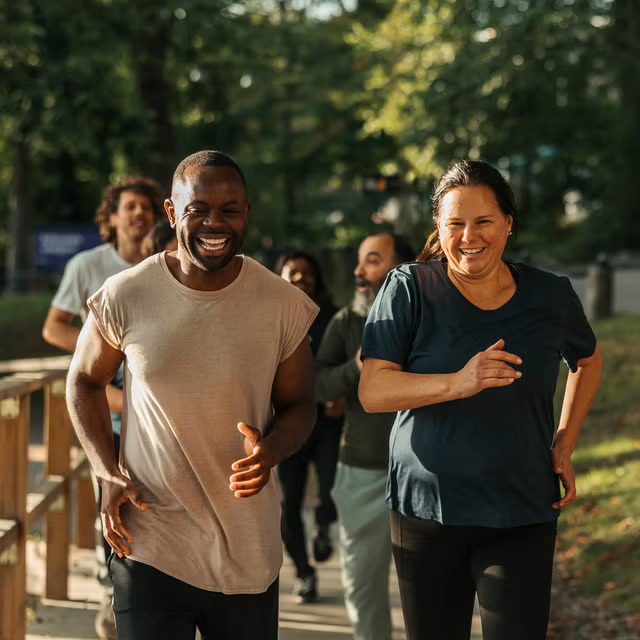
This beginner running plan in South East London gives you a practical 8-week run-walk structure to work towards your first 5K. If you have read this far through the series, something has probably shifted: you are no longer asking whether running is for you, but how to build towards a goal without doing too much too soon.
There is no single perfect route to a first 5K, but a simple run-walk structure can give you a practical place to start. This post gives you one example of an 8-week progression built around sensible beginner principles. The exact programme itself has not been validated as an injury-prevention protocol.
It uses South East London as its landscape — Southwark Park, Peckham Rye, Burgess Park and Telegraph Hill — and finishes with a goal you can actually take part in: Southwark Park parkrun, every Saturday at 9am, free, 5 kilometres and timed.
The goal is not necessarily to run every step. The goal is to complete your first 5K in a way that feels manageable for you. Walking sections still count.
Why structure can help
Motivation may get you started, but having a simple structure can make progression easier to manage. Beginner runners differ widely in fitness, previous activity, health and tissue capacity, so no single programme will suit everyone.
There is no scientifically established perfect weekly progression that guarantees a new runner will avoid injury. In a randomised trial, a slower 13-week graded programme did not produce fewer running injuries than a standard 8-week programme (Buist et al., 2008). More recent systematic-review evidence also finds inconsistent relationships between individual training parameters and running injury.
Structure is still useful — but no single formula works for everyone.
This example plan is built around three principles:
- Principle 1: Use run-walk intervals in the early weeks. Run-walk intervals make the total amount of running easier to control and may feel more manageable for complete beginners. They are also used in established beginner programmes such as NHS Couch to 5K.
- Principle 2: Keep at least one non-running day between running sessions during the early weeks. If soreness or fatigue from the previous session has not settled, consider waiting longer before the next run.
- Principle 3: Let your symptoms help guide progression. If pain is becoming more localised, increasing between sessions, changing how you run, or failing to settle when you reduce training, do not automatically progress simply because the calendar says it is time for the next week.
Before you start each session
- Begin with around 5 minutes of easy walking to gradually increase your activity level before the running intervals.
- After the session, finish with a few minutes of easy walking. Stretching is optional if it feels comfortable; it is not required to prevent running injuries.
- Aim for 3 sessions per week with at least one non-running day between sessions.
Progress check — before moving to the next week
- Did this week feel manageable?
- Have any symptoms generally returned towards your usual baseline?
- Is pain becoming more localised, more intense or more persistent?
- Is discomfort changing the way you run?
If symptoms are building rather than settling, repeat, shorten or step back a week rather than progressing automatically.
Your example 8-week beginner run-walk plan
| Week | Session structure | Running time per session | Notes |
|---|---|---|---|
| 1 | Run 1 min / Walk 2 min × 8 rounds | ~8 min | 3 sessions. Some muscle soreness can occur after unfamiliar exercise during the early weeks. |
| 2 | Run 90 sec / Walk 90 sec × 8 rounds | ~12 min | Keep the running pace comfortable enough that you could still speak a short sentence. |
| 3 | Run 2 min / Walk 2 min × 7 rounds | ~14 min | Keep the same three-session structure rather than adding another running day. |
| 4 | Run 3 min / Walk 2 min × 6 rounds | ~18 min | The running intervals may begin to feel more familiar. Keep the pace comfortable. |
| 5 | Run 5 min / Walk 2 min × 4 rounds | ~20 min | First longer continuous running intervals. Reduce pace or repeat week 4 if needed. |
| 6 | Run 8 min / Walk 2 min × 3 rounds | ~24 min | If week 5 felt demanding, repeat it before progressing. |
| 7 | Run 12 min / Walk 2 min × 2 rounds | ~24 min | The longer running intervals may begin to feel more familiar by this stage, but progression varies considerably between individuals. |
| 8 | Run 25–30 min continuously, or complete a 5K with walk breaks as needed | ~25–30 min | Southwark Park parkrun. Saturday. 9am. Free. Southwark Park parkrun |
Where to run in South East London
These local options give you different settings for your run-walk sessions as your confidence and tolerance develop.
Southwark Park (SE16) — flat and home to a local 5K parkrun
Southwark Park offers a largely flat setting that can work well for run-walk sessions as the programme progresses. Its Saturday parkrun can also provide a clear local goal for week 8.
If the idea of joining an organised 5K feels intimidating, visiting as a spectator or volunteer first can make the event feel more familiar before taking part.
Burgess Park (SE5) — flat and spacious
Burgess Park’s wide paths give beginners plenty of room to adjust the length of a run-walk session. It can be particularly useful when you want the freedom to shorten or extend a session without committing to a fixed loop.
Peckham Rye Park (SE15) — varied paths and route options
Its mix of paths and open space makes it easy to adapt a session to the amount of time or running you want to complete.
Telegraph Hill Park (SE14) — a hillier option
Once you are comfortable with your current run-walk sessions, Telegraph Hill can add some varied terrain. Hills increase the demand compared with level running, so introduce them gradually rather than because a particular week number says you should.
The Telegraph Hill Centre on Kitto Road, SE14 is also home to Momentum Body Clinic’s Telegraph Hill clinic.
When to get a clinical assessment
Most beginners do not need a clinical assessment simply because they are following a running programme. However, assessment may be useful when symptoms are stopping you progressing or making you uncertain whether continuing is appropriate.
- Pain is becoming more localised, more intense or more persistent from one run to the next.
- Discomfort is changing the way you walk or run.
- Symptoms repeatedly return when you resume running after reducing your training.
- A previous injury is making it difficult to judge how quickly you should progress.
- You are unable to progress because the same symptom keeps returning.
Where do osteopathy and movement assessment fit?
You do not need treatment simply because you have completed your first 5K. If you are running comfortably, recovering well and enjoying it, keep going.
If pain is persisting, repeatedly returning, changing how you run or preventing you from progressing, a clinical assessment may help explore the presentation in more detail.
Depending on the assessment, management may include advice about modifying training, exercise, osteopathic treatment, massage, or referral to another healthcare professional where appropriate.
Our Southwark Park Athletics Track Gym on Hawkstone Road (SE16) provides an active environment for runners and is close to Southwark Park. Consultations are also available at our Telegraph Hill clinic on Kitto Road (SE14).
Pain getting in the way of your running?
If symptoms are persisting or repeatedly returning as you progress, an initial osteopathy consultation can help assess the presentation and discuss appropriate next steps.
Prefer to ask a question first? Contact Momentum Body Clinic .
- Part 1: “I’m Not a Runner” — How to start running safely in South East London
- Part 2: Your First 4 Weeks of Running: What to Expect & What’s Normal
- Part 3: 3 Common Running Problems in Beginners
- Part 4: Running After 35: 4 Key Changes and How to Adapt
- Part 5: Your First 5K: 8-Week Beginner Running Plan (you are here)
Research and guidance
- Buist I, Bredeweg SW, van Mechelen W, et al. No effect of a graded training program on the number of running-related injuries in novice runners: a randomized controlled trial. Am J Sports Med. 2008;36(1):33–39. PMID: 17940147 .
- Videbæk S, Bueno AM, Nielsen RO, Rasmussen S. Incidence of running-related injuries per 1,000 h of running in different types of runners: a systematic review and meta-analysis. Sports Med. 2015;45(7):1017–1026. PMID: 25951917 .
- Fredette A, Roy J-S, Perreault K, et al. The association between running injuries and training parameters: a systematic review. J Athl Train. 2022;57(7):650–671. PMID: 34478518 .
This article provides general information and is not a diagnosis or personal medical prescription. Last clinically reviewed: 28 September 2026.