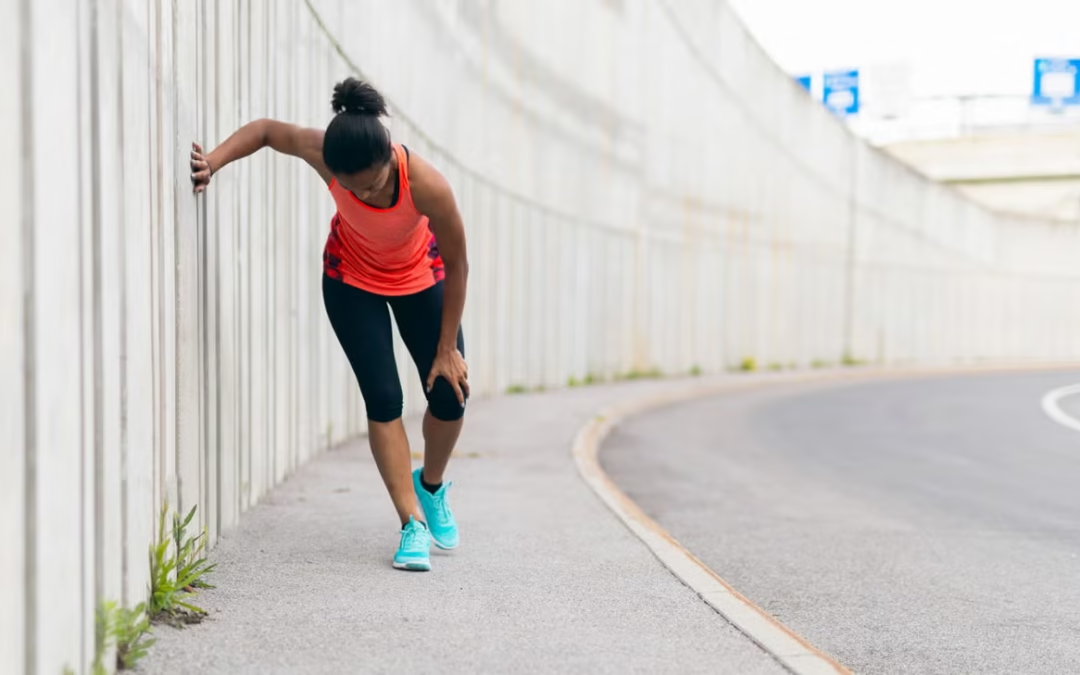
Common running injuries in beginners do not always begin with one obvious incident. You may start steadily, take rest days and feel fine — then notice a persistent ache along the shin, around the kneecap or under the heel.
It might be a persistent ache along the inner border of your shin that lingers after runs. A dull, diffuse ache around the front of your kneecap that makes walking down stairs uncomfortable. Or a sharp, tight tenderness under your heel when you take your first few steps out of bed in the morning.
These symptoms can follow recognisable clinical patterns, but the same symptom can arise from different combinations of training load, tissue capacity, previous injury and individual factors.
Running problems rarely have one universal mechanical cause
A classic retrospective analysis of more than 2,000 running-related injuries found that patellofemoral pain syndrome accounted for approximately 25% of all presentations, followed by iliotibial band discomfort, plantar fasciitis, and medial tibial stress syndrome. A subsequent meta-analysis confirmed that the knee, lower leg, and foot or ankle are consistently the most frequently injured areas in runners.
What these presentations share is a relationship between mechanical stress and current tissue capacity. However, research does not support reducing running injuries to one isolated "fault" — such as claiming your shin hurts simply because a glute muscle is weak, or your knee hurts solely because of a stiff ankle.
Training history, previous injury, tissue capacity, muscular strength, joint mobility, recovery, and individual movement characteristics can all play a role. A thorough clinical assessment looks for contributing factors rather than hunting for a single hidden culprit.
3 common patterns — and what may be involved
1. Shin pain (Medial Tibial Stress Syndrome)
What it feels like: A diffuse ache or tenderness along the inner border of the lower third of the shin bone (tibia). It is often worse at the start of a run, may ease slightly once warmed up, and returns or aches afterwards. The area is characteristically tender to press along a stretch of bone rather than at a single pinpoint spot.
What may be involved: MTSS is generally considered a load-related condition involving the tibia rather than simply a muscle or periosteal problem. A systematic review by Moen et al. found that histological evidence does not support the traditional traction-periostitis explanation. Research has identified several factors associated with MTSS, including previous MTSS, fewer years of running experience, greater navicular drop, higher BMI, female sex and some differences in hip range of motion. These are statistical associations across groups and do not mean that any one finding is the cause of an individual runner’s shin pain.
What an assessment may explore: Recent changes in running volume and pace, previous episodes of shin discomfort, foot and ankle mechanics, calf and lower-limb capacity, and how your body absorbs impact on single-leg landing.
2. Knee pain (Patellofemoral Pain Syndrome)
What it feels like: A dull, diffuse ache around the front of the knee or behind the kneecap. It is characteristically aggravated by activities that increase compressive load on the patellofemoral joint — such as walking downstairs, running, squatting, or sitting for prolonged periods with the knees bent (sometimes called the "theatre sign").
What may be involved: Patellofemoral pain is multifactorial. Current best-practice guidance recommends understanding the person’s symptoms, activity demands, relevant impairments and goals rather than blaming one movement fault or weak muscle. Education and knee-targeted exercise, with or without hip-targeted exercise, form the foundation of management. Depending on the presentation, taping, foot orthoses, movement or running retraining and manual therapy may be useful supporting interventions.
What an assessment may explore: Hip abductor and quadriceps strength, movement patterns during single-leg squats or step-downs, ankle dorsiflexion, and training volume progression.
3. Foot and heel pain (Plantar Heel Pain)
What it feels like: Pain under the base of the heel or along the medial arch of the foot. It is characteristically sharpest during the first few steps in the morning or after sitting for a while, easing after a short walk, but often aching after a longer run or prolonged standing.
What may be involved: The plantar fascia is a thick fibrous band that supports the foot arch and absorbs tensile force during running. Plantar heel pain is not simply the result of one tight muscle or an isolated bone spur. Current guidance supports an individualised approach that may include education, stretching, resistance exercise and other interventions selected according to the clinical presentation. Manual therapy may also be considered where relevant mobility restrictions are present.
What an assessment may explore: Calf strength and endurance, big toe and ankle range of motion, footwear characteristics, and recent training changes.
When to get a clinical assessment
A clinical assessment may be useful when symptoms are persistent, recurring, worsening, or making you uncertain about how to progress. Specific signals worth acting on include:
- Pain has persisted across several runs without clear improvement between sessions.
- You have already rested or reduced your running volume, but discomfort returns as soon as you restart.
- Pain is present during the run and causes you to alter how you land or stride.
- Morning stiffness or heel pain is becoming more persistent or taking progressively longer to ease after standing up.
- You have experienced this exact symptom in previous running attempts and it stopped you before.
Where do osteopathy and movement assessment fit?
At Momentum Body Clinic, the purpose of a running assessment is not to find a single "root cause" or tell you that something is broken. It is to understand the combination of factors that may be influencing your symptoms — including your recent training load, past injuries, joint movement, strength, single-leg control, and recovery habits.
Where appropriate, hands-on osteopathic mobilisation or sports massage may form part of the plan alongside load management, exercise prescription, and practical advice. If your presentation suggests that another healthcare professional, imaging, or medical referral would be more appropriate, that is clearly discussed as part of your care.
Our Southwark Park clinic is based at the Athletics Track Gym on Hawkstone Road (SE16) — a working track environment where movement and running are part of the daily setting. We also offer consultations at our Telegraph Hill clinic on Kitto Road (SE14).
Running pain that isn’t settling?
If shin, knee or heel symptoms are persisting, recurring or making you unsure whether to continue running, an initial osteopathy consultation can help assess the presentation and discuss appropriate next steps.
Prefer to ask a question first? Contact Momentum Body Clinic .
- Part 1: "I'm Not a Runner" — How to start running safely in South East London
- Part 2: Your first few weeks of running: what to expect and what is normal
- Part 3: 3 common running problems in new runners — and the factors that may contribute (you are here)
- Part 4: Running after 35: what changes and what stays trainable
- Part 5: Your first 5K in South East London — A practical 8-week run-walk plan
Research and guidance
- Taunton JE, Ryan MB, Clement DB, et al. A retrospective case-control analysis of 2002 running injuries. Br J Sports Med. 2002;36(2):95–101. PMID: 11916889.
- Lopes AD, Hespanhol Júnior LC, Yeung SS, Costa LO. What are the main running-related musculoskeletal injuries? A systematic review. Sports Med. 2012;42(10):891–905. PMID: 22827721.
- Moen MH, Tol JL, Weir A, et al. Medial tibial stress syndrome: a critical review. Sports Med. 2009;39(7):523–546. PMID: 19530750.
- Newman P, Witchalls J, Waddington G, Adams R. Risk factors associated with medial tibial stress syndrome in runners: a systematic review and meta-analysis. Open Access J Sports Med. 2013;4:229–241. PMID: 24379729.
- Willy RW, Hoglund LT, Barton CJ, et al. Patellofemoral pain: clinical practice guidelines. J Orthop Sports Phys Ther. 2019;49(9):CPG1–CPG95. PMID: 31475628.
- Neal BS, Lack SD, Bartholomew C, Morrissey D. Best practice guide for patellofemoral pain based on synthesis of a systematic review, the patient voice and expert clinical reasoning. Br J Sports Med. 2024;58(24):1486–1495. PMID: 39401870.
- Koc TA Jr, Bise CG, Neville C, Carreira D, Martin RL, McDonough CM. Heel Pain — Plantar Fasciitis: Revision 2023. J Orthop Sports Phys Ther. 2023;53(12):CPG1–CPG39. PMID: 38037331.
- Rathleff MS, Mølgaard CM, Fredberg U, et al. High-load strength training improves outcome in patients with plantar fasciitis: a randomized controlled trial with 12-month follow-up. Scand J Med Sci Sports. 2015;25(3):e292–e300. PMID: 25145882.
This article provides general information and is not a diagnosis or personal medical prescription. Last clinically reviewed: 28 September 2026.