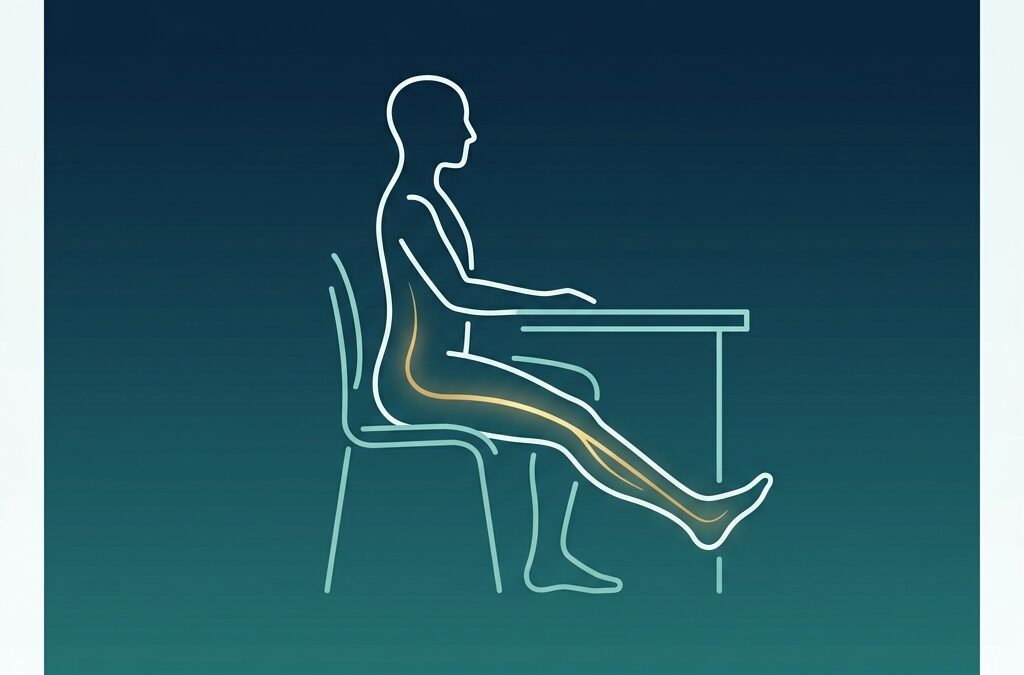
Can sitting aggravate sciatica? Yes, leg pain, tingling or numbness may build during a long meeting, commute or day at the computer. However, this does not necessarily mean that a chair is trapping the sciatic nerve or that a disc is being pushed farther out.
More often, sitting is one position that your back and leg currently tolerate poorly. The aim is not to find one “perfect” posture. It is to vary your position, reduce long uninterrupted periods of sitting and rebuild tolerance gradually.
Can sitting aggravate sciatica without causing damage?
Evidence specifically linking ordinary office sitting with the onset of sciatica is limited. In many cases, symptoms are aggravated by the position rather than caused by the chair itself. Most workplace research concerns lower back pain rather than confirmed nerve-root-related leg pain.
A 2025 scoping review of office-worker research found associations between lower back pain and factors such as longer sitting time, fewer breaks, more static sitting and some sitting postures. However, an association does not prove that sitting caused the pain, and the findings cannot be applied directly to every person with sciatica.
A more useful way to describe the problem is: “Sitting currently aggravates my symptoms.” That leaves room to change the position, duration and work setup without assuming that damage is occurring.
Why can sitting aggravate sciatica?
There is no single explanation that applies to everybody. Possible contributors include:
- Sustained position: the lower back, hip and leg remain in one position for a prolonged period.
- Reduced movement variety: symptoms may build when there are few opportunities to move, stand or walk.
- Individual sensitivity: particular combinations of hip, knee, ankle and spinal position may reproduce leg symptoms.
- Overall load: poor sleep, work pressure and a sudden increase in sitting time may reduce how much activity you can comfortably tolerate.
These factors may influence symptoms, but they do not support a universal “double-pinch” explanation in which a chair crushes the sciatic nerve while sitting simultaneously forces a disc onto a nerve root.
What is a nerve slider?
Neural mobilisation is a movement-based approach intended to move neural tissues in relation to the surrounding structures. A slider alternately increases movement at one end of the neural pathway while easing it at the other. It is different from holding a strong stretch at the end of range.
Ultrasound research in healthy participants confirms that the sciatic nerve moves slightly during ankle and leg movement. The measured movement varies with position and is reported in millimetres. These studies demonstrate movement, but they do not prove that sciatica is caused by a nerve being stuck, rubbing or losing its blood supply.
What does the research say about neural mobilisation?
The overall picture is promising but uncertain.
- A 2023 meta-analysis of 20 trials reported pooled improvements in pain and disability for people described as having lumbar radiculopathy. The studies used different techniques and treatment programmes, heterogeneity was high and publication bias was a concern.
- A separate systematic review found that neural mobilisation may improve short-term pain, function and disability, while emphasising the need for better-quality trials.
- A 2021 controlled trial found short-term improvements when slider or tensioner exercises were added to transcutaneous electrical nerve stimulation (TENS), compared with TENS alone. It did not establish long-term benefit or measure nerve swelling, oxygenation or blood flow.
- A small 2025 randomised trial found better short-term outcomes when a slump-position slider was added to a conventional physiotherapy programme. It does not establish one ideal self-treatment technique or dosage for everybody.
In practical terms, a nerve slider may be a useful option for selected people. It should not be presented as a cure, a way to “unpin” a nerve or a replacement for assessment when symptoms are severe, unusual or worsening.
How to try a gentle seated nerve slider
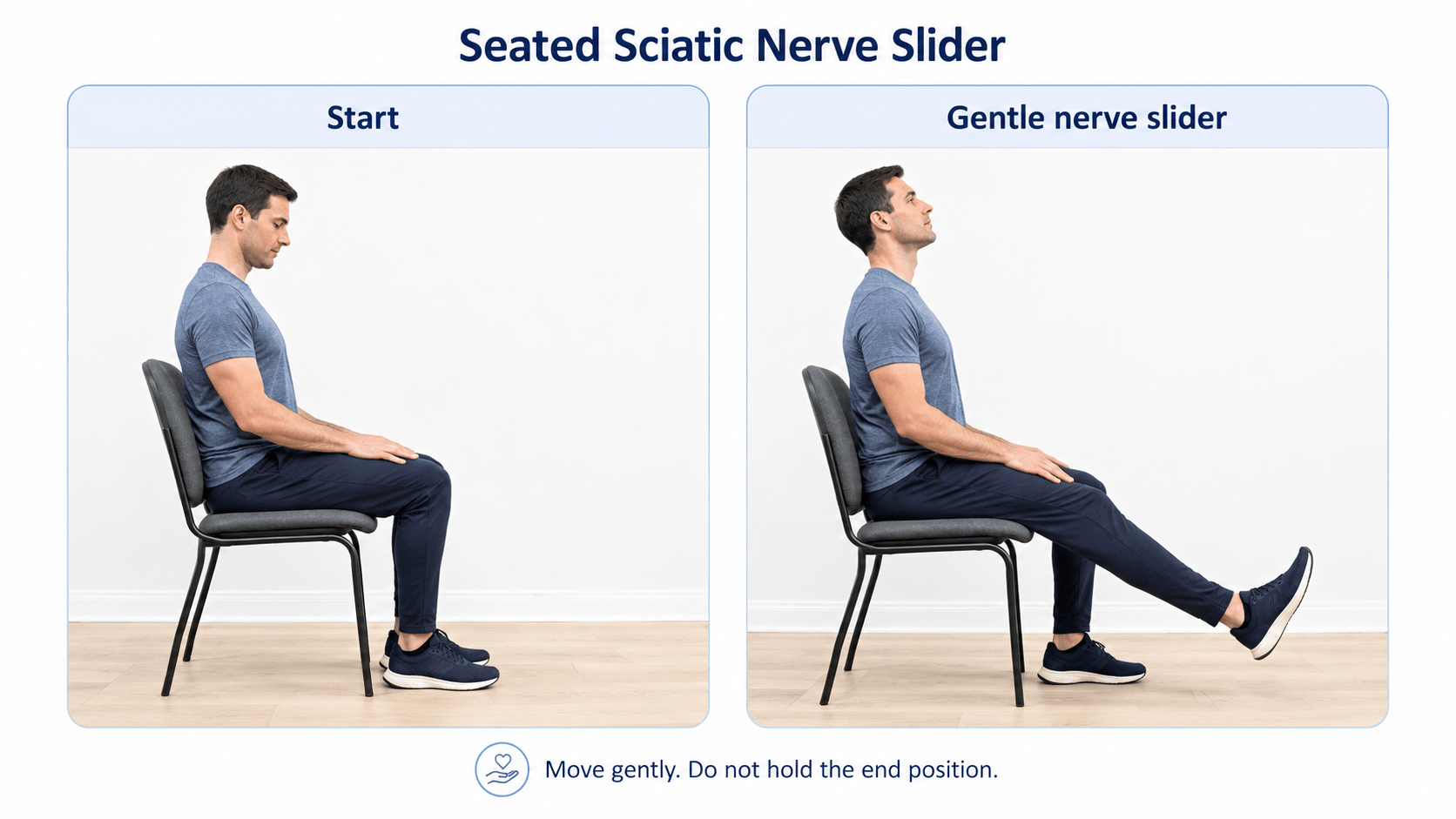
The following is one commonly used variation. There is no universal dosage, and the movement may need to be changed after an individual assessment.
- Sit on a stable chair with both feet supported and your hands resting comfortably.
- Slowly straighten the symptomatic leg through a comfortable range while gently lifting your head and looking slightly upward.
- Return the foot to the floor as you gently lower your chin.
- Keep the foot and ankle relaxed. Do not force the knee straight, bounce or hold the end position.
- Begin with 5 slow repetitions once a day. Increase only when the movement does not leave symptoms noticeably worse.
Do not begin this exercise as a self-treatment when you have new or progressive weakness, symptoms in both legs, saddle-area sensory changes, or changes to bladder or bowel function. Seek medical assessment instead.
Five practical strategies for sitting with sciatica
- Change position before symptoms become severe. There is no universally proven 20- or 40-minute rule. Choose an interval that is realistic and responsive to your symptoms.
- Use more than one acceptable posture. Upright sitting, slight recline, standing and brief walking can all be useful. No single posture needs to be held all day.
- Support your feet and forearms. A stable setup may reduce unnecessary muscular effort, although ergonomics alone will not cure sciatica.
- Use short movement breaks. Stand, walk to another room or perform a comfortable movement for one or two minutes.
- Build tolerance gradually. If 45 minutes of sitting causes a major flare, begin with a duration you tolerate and increase it progressively rather than avoiding sitting completely.
Should you stretch your hamstrings?
A forceful toe-touch or hamstring stretch may reproduce nerve-related symptoms in some people. That does not make hamstring stretching universally harmful, and there is no good clinical evidence that an ordinary stretch cuts off the sciatic nerve’s blood supply.
Reduce the range or stop if a stretch produces electric pain, tingling, numbness or symptoms that travel farther down the leg and remain worse. A gentle slider may be better tolerated, although it is not automatically the right exercise for every presentation.
When is an assessment useful?
Consider an assessment when symptoms aggravated by sitting are getting worse, are affecting sleep or normal activity, have not started to improve after a few weeks, or include persistent numbness or weakness. An assessment can help distinguish back-related nerve symptoms from other possible causes of leg pain and guide an appropriate movement or exercise plan.
Osteopathic mobilisation or soft-tissue treatment may help some people move more comfortably. The National Institute for Health and Care Excellence (NICE) recommends considering manual therapy only as part of a treatment package that includes exercise, and advises against traction for lower back pain with or without sciatica.
When to seek emergency help
Go to accident and emergency (A&E) or call 999 if you develop sciatica on both sides; severe or worsening weakness or numbness in both legs; numbness around the genitals or anus; new difficulty starting, controlling or feeling urination; or loss of bowel sensation or control. These can be signs of a serious spinal problem requiring urgent hospital assessment.
New foot drop or progressive weakness affecting one leg also needs prompt medical assessment.
Frequently asked questions
Can sitting aggravate sciatica without damaging a nerve?
No. Sitting is not automatically harmful, but it may aggravate symptoms for some people. Varying position and gradually rebuilding sitting tolerance is usually more practical than avoiding sitting completely.
How often should I get up from my desk?
There is no single evidence-based interval for everyone. Start by changing position before symptoms become intense, then adjust the interval according to your response and work demands.
Can a standing desk cure sciatica?
No. A standing desk may help you vary position, but it is not a treatment by itself. Alternating sitting, standing and brief movement is generally more useful than staying in either position all day.
How do I know if a nerve slider is too strong?
Reduce or stop if symptoms become sharper, spread farther down the leg, include increasing numbness or weakness, or remain noticeably worse afterwards.
Book an osteopathy assessment
If sitting-related back or leg symptoms are affecting work, sleep, walking or training, an assessment can help clarify the pattern, screen for signs that need medical referral and create an individual management plan.
Prefer to ask a question first? Contact Momentum Body Clinic.
Research and guidance
- Alaca N, Acar AÖ, Öztürk S. Low back pain and sitting time, posture and behavior in office workers: a scoping review. J Back Musculoskelet Rehabil. 2025;38(5):919–943. PMID: 40111906.
- Alshami AM, Alshammari TK, AlMuhaish MI, et al. Sciatic nerve excursion during neural mobilization with ankle movement using dynamic ultrasound imaging. J Ultrasound. 2022;25(2):241–249. PMID: 34036554.
- Lin LH, Lin TY, Chang KV, Wu WT, Özçakar L. Neural Mobilization for Reducing Pain and Disability in Patients with Lumbar Radiculopathy: A Systematic Review and Meta-Analysis. Life (Basel). 2023;13(12):2255. PMID: 38137856.
- Peacock M, Douglas S, Nair P. Neural mobilization in low back and radicular pain: a systematic review. J Man Manip Ther. 2023;31(1):4–12. PMID: 35583521.
- Alshami AM, Alghamdi MA, Abdelsalam MS. Effect of Neural Mobilization Exercises in Patients With Low Back-Related Leg Pain With Peripheral Nerve Sensitization: A Prospective, Controlled Trial. J Chiropr Med. 2021;20(2):59–69. PMID: 34987322.
- Shaheen HM, Belgen Kaygisiz B. Comparison of different treatment positions of nerve slider technique for patients with low back pain: a randomized control trial. Eur J Phys Rehabil Med. 2025;61(1):82–92. PMID: 39873676.
- National Institute for Health and Care Excellence. Low back pain and sciatica in over 16s: assessment and management (NG59).
- National Health Service. Sciatica: symptoms, self-care and when to get urgent help.
This article provides general information and is not a diagnosis or individual medical prescription. Last clinically reviewed: 14 July 2026.